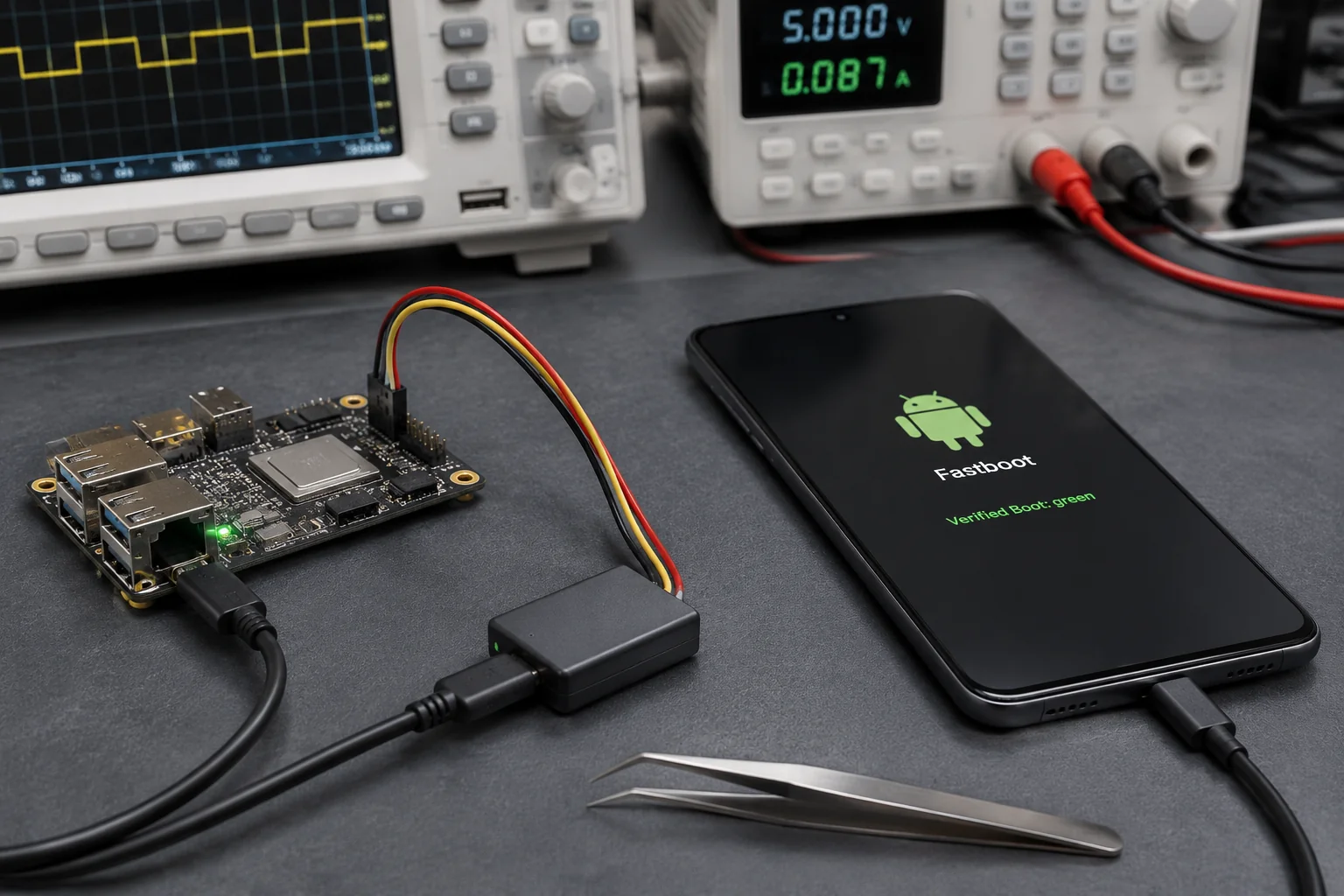
1. Security vs. Privacy: Why Telemetry Stripping Alone Fails Modern Threat Models
A persistent fallacy in consumer privacy guides is treating privacy (stopping corporate telemetry) and security (resisting memory-corruption exploits, baseband attacks, and physical forensics) as competing goals. Removing proprietary background daemons from an operating system achieves nothing if the resulting system ships three months late on Chromium WebView patches, disables compiler Control Flow Integrity (CFI), or requires leaving the hardware bootloader unlocked.
In 2026, endpoint defense must simultaneously defeat two distinct adversaries:
- Privileged OEM & Ad-Tech Telemetry: Stock Android distributions (
OneUI,HyperOS,ColorOS, and stock Pixel OS) execute Google Play Services (com.google.android.gms) with privilegedsignature|privilegedsystem permissions, continuous Wi-Fi/Bluetooth BSSID location scanning, and persistent hardware identifiers feeding commercial location and data-broker pipelines. Desktop browsers similarly embed background crash/impression pingers, advertising attribution APIs (Privacy-Preserving Attribution/Topics API), and default search-revenue hooks. - Exploit Chains & Physical Extraction (
Cellebrite/GrayKey/ Zero-Click Spyware): Commercial mobile forensic appliances (UFED) and mercenary spyware vendors exploitC/C++spatial and temporal memory safety bugs (use-after-freeand heap buffer overflows) insideWebRTC, image codecs, font rasterizers, USB kernel drivers, and Just-In-Time (JIT) JavaScript compilers. Only hardware-enforced Verified Boot, cryptographic Before-First-Unlock (BFU) key eviction, automatic reboot timers, USB-C hardware port disabling, and memory-tagging allocators neutralize these vectors.
2. Hardened Mobile & Desktop OS Engineering Analysis
2.1 GrapheneOS: Hardware Arm MTE, hardened_malloc, and Sandboxed Google Play
GrapheneOS stands alone in open-source systems engineering because it raises both privacy and offensive exploit costs far above stock OEM Android:
- Armv9 Memory Tagging Extension (
MTE) +hardened_malloc: On Pixel 8, Pixel 9, and Pixel 10 (Tensor G3/G4/G5Armv9 cores), GrapheneOS enforces synchronous asymmetric/symmetric hardwareMTEacross the base system and installed applications alongside its custom slab-isolatedhardened_mallocallocator. Every16-byte memory granule receives a4-bit cryptographic tag checked in silicon against pointer upper bits (TBI), deterministically crashing spatial overflows and temporaluse-after-freeexploits before attacker shellcode can pivot. - Unprivileged Sandboxed Google Play: Rather than re-implementing Google APIs via signature spoofing (
microG), GrapheneOS teaches the OS compatibility layer to run unmodifiedGoogle Services Framework,GMS, andPlay Storeinside standard unprivileged app sandboxes (UID u0_a...). Users can install banking apps or hardware-attested corporate authenticators inside a dedicated secondary Android User Profile, revokeNetworkorSensorspermissions per app at the kernel socket/HAL level, and terminate the entire profile immediately after use so zero background Google daemons run in the primary profile. - Physical & Forensics Countermeasures (
BFUAuto-Reboot + USB-C Port Lockdown + Duress PIN): Mobile forensic extractors (Cellebrite/GrayKey) overwhelmingly rely on exploiting devices sitting in the After First Unlock (AFU) state (where file-based encryption keys reside in kernel RAM) over USB data lines. GrapheneOS enforces a configurable Auto-Reboot timer (defaulting to18hours, tunable down to10minutes) returning idle locked devices to the cold Before First Unlock (BFU) state, disables USB-C data pins at the hardware controller level (Charging-onlyorOffwhile locked), supports64-character passphrases via Weaver secure-element throttling, and includes a Duress Password/PIN that instantaneously wipes hardware keyslots and zeroes eSIM credentials upon entry.
2.2 CalyxOS: July 2026 v7.2.2.0 Open-Source HSM Relaunch & microG Trade-Offs
For years, CalyxOS served users seeking a gentler learning curve via pre-bundled microG, Datura firewall toggles, and Seedvault encrypted backups. Following leadership transitions at the Calyx Institute in mid-2025, CalyxOS entered an extended release pause to overhaul its build-signing infrastructure from scratch, returning to active production in July 2026 with CalyxOS v7.2.2.0 (Android 16) backed by an audited, open-source Hardware Security Module (HSM) code-signing pipeline and reproducible key-ceremony governance.
When choosing between CalyxOS vs. GrapheneOS in 2026:
- Choose GrapheneOS whenever your threat model involves targeted zero-day exploit resistance (
Arm MTE,VanadiumJIT-less WebView), instantaneous monthly/zero-day Android security bulletin parity, zero signature-spoofing hooks, or high-value self-custody signing and FIDO2 passkey operations. - Consider CalyxOS (
v7.2.2+) when deploying devices for non-technical family members who want out-of-the-boxmicroGpush notifications without ever signing into a Google account, provided the target Pixel device remains within active OEM firmware support.
2.3 Apple iOS Lockdown Mode vs. Stock OEM Android (Samsung Knox)
When hardware procurement rules mandate Apple silicon (iPhone) or enterprise Samsung handsets:
- iOS Lockdown Mode: Introduced in iOS 16 and substantially expanded through iOS 18/19, Apple's Lockdown Mode shrinks the remote zero-click attack surface dramatically: JavaScript
JITcompilation in WebKit is disabled system-wide,BlastDoorstrips complex attachment/font parsing in iMessage, incoming FaceTime/Shared Album invites from unknown contacts are dropped, wired Lightning/USB-C data connections are blocked while locked, unencrypted2Gcellular baseband registration is disabled, and open Wi-Fi auto-join is suppressed. Combine Lockdown Mode with Advanced Data Protection (ADP) so iCloud backups use client-held end-to-end keys rather than Apple-held keys. Note the boundary: Lockdown Mode hardens against external spyware, not Apple's own first-party App Store /APNsmetadata telemetry. - Stock OEM Android (
Samsung Galaxy/OneUI): While Samsung's hardwareKnox VaultSecure Element is well-engineered against physical voltage glitching, OneUI ships dense dual-stack telemetry (both Google Play Services AND Samsung Customization Service / Bixby / Galaxy Store trackers). Mitigations on stock OEM hardware (ADB pm disable-userdebloating, Private DNS, and Work Profile isolation viaShelter/Insular) reduce surface noise but cannot strip privileged system UIDs or addArm MTEallocator hardening.
2.4 Linux Laptops, Coreboot Open Firmware, and Qubes OS Compartmentalization
Desktop OS hardening begins below the kernel inside SPI flash firmware:
Coreboot+ IntelME/ AMDPSPNeutralization: Proprietary UEFI implementations contain millions of lines of closed SMM (System Management Mode) Ring-2code alongside Intel Management Engine (ME) out-of-band co-processors. Linux hardware vendors audited by the community (including Star Labs, System76, and NovaCustom / Dasharo) ship open-source Coreboot +EDK IIfirmware with Intelme_cleaner/ HAP-bit neutralization, firmware write-protect switches, andTPM 2.0Measured Boot (LUKS2full-disk encryption unlocked viasystemd-cryptenroll+ PIN).Qubes OS(XenType-1 Hypervisor): For investigative journalists, security auditors, and multisig coordinators handling untrusted PDFs or NPM repositories,Qubes OSisolates networking (sys-net), USB controllers (sys-usb), Tor routing (sys-whonix), and disposable browser/attachment VMs (dispXXXX) in hardware-virtualized domains so a full browser+kernel compromise inside a disposable VM never touches SSH keys or wallet vaults.
3. Master Hardened OS & Browser Anti-Fingerprinting Matrix (2026)
Test your own browser's live Canvas, WebGL, AudioContext, Sec-GPC, and WebRTC posture right now inside DT.gl's Anti-Tracking & Fingerprint Inspector.
| OS / Browser Target | Boot / Process Isolation | Memory & JIT Hardening | First-Party Telemetry | Fingerprinting / Partitioning Strategy | Primary Threat-Model Fit |
|---|---|---|---|---|---|
| GrapheneOS (Pixel 8/9/10) | Locked Bootloader (AVB 2.0 custom key) + per-app Network/Sensor toggles | Armv9 MTE + hardened_malloc + dynamic code/JIT restrictions | Zero (0 Google/OEM pings; NTP/connectivity checks use grapheneos.org) | MAC per-SSID randomization + unprivileged Sandboxed Play profiles | Highest assurance mobile security & privacy available in 2026 |
CalyxOS v7.2.2+ (Pixel) | Locked Bootloader (AVB 2.0 via July 2026 Open-Source HSM) + Datura Firewall | Standard AOSP Scudo allocator (no hardened_malloc custom layer) | Minimal (de-Googled AOSP; optional microG connects to Google push/auth) | Per-network MAC randomization + Work Profile isolation | Turnkey de-Googled usability after 2026 HSM signing governance overhaul |
| iOS 18/19 + Lockdown Mode | Apple Secure Boot Chain + Secure Enclave + BlastDoor sandbox | Pointer Auth (PAC) + Memory Integrity Enforcement + WebKit JIT Disabled | Moderate-High (Apple APNs, iCloud analytics; disable Siri/Search/Ad tracking) | Safari ITP + iCloud Private Relay (OHTTP 2-hop IP masking) | Executives/journalists bound to Apple ecosystem facing spyware risk |
| Coreboot Linux / Qubes OS | Open Coreboot/Dasharo SPI flash + ME disabled + Xen VM / Wayland isolation | Hardened kernel / Xen hypervisor (dom0 air-gapped from sys-net & sys-usb) | Zero (user-controlled Debian/Fedora/Arch minimal templates) | Hardware VM separation (sys-whonix forces Tor stream isolation) | Workstation malware containment, code auditing & cold-ops coordinators |
| Tor Browser (v14+) | Gecko ESR sandbox + built-in 3-hop Tor circuit per first-party URL bar domain | Security Level: Safest disables JS (JIT + Wasm + SVG script execution) | Zero (0 Mozilla telemetry, 0 Pocket/Sponsored tiles) | Strict Crowd Uniformity (RFP + Letterboxing + Tor exit IP anonymity) | Maximum network + browser anonymity against state/ISP adversaries |
| Mullvad Browser | Gecko ESR process sandbox (designed to run over WireGuard VPN without Tor latency) | Optional Safest NoScript toggle; strips WebGPU & gamepad enumerators | Zero (built with Tor Project; zero auto-telemetry or sync accounts) | Strict Crowd Uniformity (identical screen letterboxing & font allowlist) | Low-latency clearnet browsing with Tor-Browser-grade anti-fingerprinting |
| Brave Browser (Strict) | Chromium full Site Isolation (1 OS process per origin; superior to Gecko Fission) | Chromium MiraclePtr (BackupRefPtr) + V8 sandbox (V8 Optimizer off option) | Low after opt-out (must disable Brave Rewards, Leo AI, VPN promo & P3A) | Per-Session Farbling (deterministic eTLD+1 noise on Canvas/Audio/WebGL) | Daily-driver Chromium sandbox safety + seamless web compatibility |
| Vanadium (GrapheneOS) | Chromium Site Isolation + GrapheneOS SELinux & hardened_malloc integration | JavaScript JIT disabled by default (per-site opt-in) + CFI + Arm MTE | Zero (all Google Chromium telemetry & field-trial pings stripped) | State partitioning + reduced User-Agent Client Hints | Hardest mobile browser/WebView engine against remote 0-day RCE |
| LibreWolf (Desktop) | Gecko Fission site isolation (weaker Linux OS sandbox than Chromium) | Standard SpiderMonkey JIT (can disable javascript.options.ion manually) | Zero (strips Mozilla Glean, Normandy studies, Pocket & Firefox Sync default) | RFP (resistFingerprinting) + dFPI Total Cookie Protection + uBlock Origin | Telemetry-free Firefox fork for users needing Gecko manifest v2 extensions |
4. Hardware Verified Boot & Browser Anti-Fingerprinting Architecture Diagram
Armv9 MTE), multi-user profile sandboxing, and deterministic browser fingerprint defenses.5. Browser Engine Trade-Offs: Mozilla Governance, Gecko vs. Chromium Sandboxing, and dFPI
Between 2020 and 2026, three engineering realities reshaped browser security recommendations across technical communities (Lobste.rs, Tildes, PrivacyGuides):
- Process Sandbox Asymmetry (
Chromiumvs.Gecko): Google's Blink/Chromium engine enforces strict1-origin-per-process Site Isolation, fine-grained Win32k/Linuxseccomp-bpfrenderer sandboxes, andMiraclePtr(BackupRefPtr) UAF mitigations across desktop and Android. Mozilla's Gecko engine still lags Chromium on Android process isolation (where GeckoView historically lacked full desktop-equivalent site isolation) and Linux namespace sandboxing. Consequently, on Android, GrapheneOS's Chromium-based Vanadium (with JavaScriptJITdisabled by default) is markedly harder to exploit than mobile Firefox forks (Fennec/IronFox). - Mozilla Corporate Telemetry & Defaults Drift: Stock Firefox progressively introduced default telemetry (
Glean), sponsored Pocket/New-Tab placements, and in 2024 enabled experimental Privacy-Preserving Attribution (PPA) ad-measurement APIs on an opt-out basis alongside updated 2025 Firefox Terms of Use language that sparked widespread community scrutiny. Users who rely on Gecko on desktop should run Mullvad Browser (for non-persistent anti-fingerprinting sessions) or LibreWolf (for persistent bookmarked sessions withPPA,Glean, and Pocket stripped at compile time). - Why Naive Extension Stacking Backfires: Adding five overlapping "privacy extensions" (
CanvasBlocker+Privacy Badger+User-Agent Switcher+NoScript+ClearURLs) creates a1-in-500,000extension-timing and feature-vector fingerprint (Pitfall: Paradoxical Uniqueness). Run onlyuBlock Origin(which comes pre-installed in Mullvad Browser and LibreWolf, or built natively in Rust inside Brave Shields) and let the browser engine itself enforce Dynamic First-Party Isolation (dFPI/ Total Cookie Protection), ephemeral storage partitioning, andSec-GPC: 1Global Privacy Control headers.
6. Historical Citation Archive & 2026 Empirical Upgrades
Archival Citation Ledger (16 Legacy OS & Browser Citations Upgraded to 2026)
Archival provenance note: Prior to May 2025, legacy URLs on dt.gl hosted the multi-part Privacy Cookbook series, GrapheneOS vs. CalyxOS benchmarks, Star Labs Linux reviews, and Mozilla governance audits cited on English Wikipedia, Lobste.rs, Tildes.net, and GitHub security guides. Every cited slug is preserved and updated below.
The Privacy Cookbook Technical Hardening Series Collection
Cited via dofollow links across 6 referring domains including Firefox hardening repository brainfucksec.github.io and developer blog lqdev.me as a structured curriculum for progressive endpoint, DNS, browser, and mobile de-telemetry hardening.
2026 Empirical Upgrade: DT.gl supersedes fragmented 2020 blog chapters with living, version-controlled engineering hubs covering Encrypted DNS & ODoH, Post-Quantum Messengers, FIDO2 & MCP Security, and provably offline CSP: connect-src 'none' browser verification tools.
Progressive Threat-Modeling Curriculum Index (Lobste.rs Reference)
Discussed on the computing community lobste.rs as an accessible syllabus ordering operational security steps from basic DNS/browser hygiene to full mobile OS replacement.
2026 Empirical Upgrade: Modern threat modeling separates passive mass-surveillance hygiene (Mullvad/Brave browser, encrypted DNS, statutory data-broker deletion) from active exploit & physical seizure defense (GrapheneOS Arm MTE, BFU auto-reboot, hardware security keys, air-gapped wallet signing) so users never sacrifice security patches chasing niche tweaks.
De-Googling Threat Model: Account Unlinking & Play Services Telemetry
Cited via dofollow educational resources on privacyliteracy.com examining how Google unifies Chrome sync, Android GMS location check-ins, Gmail receipt parsing, and Google Analytics across third-party properties.
2026 Empirical Upgrade: Complete Google elimination no longer requires abandoning app compatibility. Running GrapheneOS keeps the primary Owner profile 100% free of Google binaries while confining unavoidable work or transit apps inside a dedicated secondary user profile with unprivileged Sandboxed Google Play and network/sensor revocation.
CalyxOS Mobile Security Architecture & Verified Boot Review
Referenced on lobste.rs evaluating CalyxOS's locked-bootloader Pixel installation flow, built-in Datura firewall, and optional microG compatibility layer.
2026 Empirical Upgrade: After pausing OTA updates in mid-2025 during leadership transitions at the Calyx Institute, CalyxOS rebuilt its signing pipeline around an open-source Hardware Security Module (HSM) architecture and resumed Android 16 production releases with v7.2.2.0 in July 2026. Users running pre-2026 CalyxOS builds must perform a clean migration to the new HSM signing lineage to receive security updates.
Comparative Audit: CalyxOS vs. GrapheneOS Threat-Model Trade-Offs
Cited on mobile security forums (forums.crackberry.com) at a time when GrapheneOS lacked Play Services compatibility and forced users to choose between strict bare-AOSP isolation (GrapheneOS) and microG app support (CalyxOS).
2026 Empirical Upgrade: That historical trade-off was resolved when GrapheneOS invented unprivileged Sandboxed Google Play, offering higher real-world app compatibility than microG (including hardware-backed Play Integrity basic/device checks where permitted) without privileged system hooks, alongside exclusive Armv9 MTE and hardened_malloc exploit defenses.
GrapheneOS Hardening Primitives & Memory Allocator Engineering Notes
Linked via dofollow developer notes on danterobinson.dev summarizing GrapheneOS's kernel, SELinux, WebView (Vanadium), and hardened allocator design decisions.
2026 Empirical Upgrade: GrapheneOS's WebUSB-based browser installer (grapheneos.org/install/web) now flashes and re-locks supported Pixel devices in under ten minutes directly from Chromium/Brave without manual fastboot scripting errors, while adding hardware MTE, Contact Scopes, Storage Scopes, and Duress PIN wipe capabilities.
Star Labs Linux Hardware, Coreboot Firmware & Intel ME Neutralization
Cited in English Wikipedia's hardware vendor discussions (Coreboot ecosystem / Star Labs Systems) reviewing UK Linux laptop maker Star Labs (StarBook / Byte / StarLite) and its commitment to open-source firmware and LVFS (fwupd) updates.
2026 Empirical Upgrade: Open-firmware Linux laptops from Star Labs, System76, and Dasharo-certified NovaCustom hardware remain foundational for workstation sovereignty: shipping coreboot + EDK II payloads, Intel Management Engine (ME) disabling, physical/EC microphone-camera kill switches, and Linux Vendor Firmware Service (fwupd) cryptographic capsule updates.
Mozilla Engineering Layoffs, Servo/Rust Restructuring & Browser Monoculture Risk
Cited via dofollow discussion on tildes.net following Mozilla Corporation's August 2020 layoff of 250 engineers (including members of the Servo, Rust, MDN, and threat-management teams) despite rising executive compensation.
2026 Empirical Upgrade: Preserving an independent non-Blink browser engine (Gecko, alongside Servo under Linux Foundation Europe and Ladybird) remains vital against Chromium web-standards monopoly. However, security-conscious Gecko users in 2026 increasingly rely on independent hardened builds (Mullvad Browser and LibreWolf) that decouple Gecko's rendering engine from Mozilla Corporation's commercial telemetry and ad-tech initiatives.
Firefox Default Telemetry, Studies & Cliqz/Pocket Integration Audit
Referenced via dofollow technology analysis on techrights.org documenting default outbound connections (telemetry.mozilla.org, Normandy remote studies, and sponsored suggestions) emitted by freshly installed stock Firefox profiles.
2026 Empirical Upgrade: Stock Firefox 128+ added opt-out Privacy-Preserving Attribution (PPA) alongside Mozilla's acquisition of ad-measurement firm Anonym. Rather than maintaining fragile manual user.js overrides that risk breaking updates, deploy Mullvad Browser or LibreWolf where Glean, Normandy, Sponsored Suggest, and PPA are disabled cleanly at build time.
Search-Default Revenue Dependence & Antitrust Structural Conflict
Cited via dofollow German commentary on schubladenerinnerungen.de analyzing Mozilla Corporation's ~80%+ revenue reliance on Google default search placement contracts.
2026 Empirical Upgrade: Following federal DOJ antitrust remedies scrutinized in 2024-2026 over default search exclusivity agreements, browser funding incentives directly dictate default privacy settings. Always swap default search engines immediately to non-profiling meta/independent indexes (such as DuckDuckGo HTML/Lite, Brave Search independent index, Kagi privacy pass, or self-hosted SearXNG).
Apple iOS System Hardening Checklist & Telemetry Minimization
Preserved in federated privacy archives (collapse.cat) detailing iOS 14.5+ App Tracking Transparency (ATT), Significant Locations disabling, and Analytics sharing opt-outs.
2026 Empirical Upgrade: Essential 2026 iOS hardening comprises four high-leverage switches: (1) enable Advanced Data Protection (ADP) for E2EE iCloud storage (or disable iCloud backups entirely); (2) enable Lockdown Mode for high-risk travel or journalism; (3) enable Stolen Device Protection (Always mode); and (4) install a signed encrypted DoH/ODoH DNS profile alongside disablement of Apple Personalized Ads.
Open-Source iOS Application Replacements & WebKit Sandbox Constraints
Referenced on collapse.cat curating open-source iOS replacements for notes, mail, 2FA, VPN, and browser clients within App Store constraints.
2026 Empirical Upgrade: Recommended open-source iOS essentials include Signal / SimpleX Chat (comms), Standard Notes / Notesnook / local Obsidian (vaults), 2FAS / Ente Auth or hardware FIDO2 NFC YubiKeys (auth), Mullvad / Proton VPN (WireGuard), and Safari with AdGuard/Wipr content blockers or Brave iOS.
Apple Privacy Marketing vs. On-Device NeuralHash Client-Side Scanning Controversy
Archived on collapse.cat analyzing Apple's August 2021 announcement of on-device NeuralHash perceptual photo scanning and first-party Apple Search Ads expansion.
2026 Empirical Upgrade: Following sustained cryptographer resistance demonstrating perceptual hash collision attacks, Apple formally abandoned iCloud Photo NeuralHash scanning and shipped E2EE Advanced Data Protection in December 2022. However, the episode established a permanent engineering rule: only auditable open-source operating systems can guarantee the absence of silent client-side scanning hooks across future OS updates.
Samsung Galaxy OEM Android Telemetry Reduction (Part 1: System Settings & Knox)
Referenced on collapse.cat walking users bound to carrier-locked Samsung hardware through disabling Customization Service, Diagnostic Data, Samsung Push, and nearby device scanning.
2026 Empirical Upgrade: On Samsung OneUI 7/8 devices where bootloader unlocking is blocked or destroys Knox hardware attestation, enable Auto Blocker (Maximum Restrictions) to disable 2G baseband downgrade attacks and block unauthorized USB cable commands while locked, disable Link to Windows and Samsung Cloud sync, and enforce DoT Private DNS (dns.quad9.net or NextDNS).
Samsung Galaxy OEM Android Isolation (Part 2: Work Profiles & Firewalling)
Archived on collapse.cat covering Shelter Android Work Profile compartmentalization, NetGuard/RethinkDNS local VPN firewalling, and safe ADB bloatware suspension without breaking OTA updates.
2026 Empirical Upgrade: Android 15/16 natively introduced Private Space, providing built-in secondary encrypted profile isolation on stock OEM Android without requiring third-party Device Admin apps. Pair Private Space with RethinkDNS (per-UID firewall + ODoH) when carrier/enterprise rules prevent migrating to a Pixel running GrapheneOS.
Milestone Review of Mobile OS Privacy Controls (Clipboard, Indicators & Sandboxed Play)
Referenced on collapse.cat reviewing 2021's breakthrough mobile OS controls: camera/microphone hardware indicators, coarse location permissions, clipboard read alerts, and GrapheneOS's initial Sandboxed Play prototype.
2026 Empirical Upgrade: Five years on, mobile OS defenses have progressed from UI indicators to silicon-enforced memory tagging (Armv9 MTE), Storage & Contact Scopes (returning empty zero-entry arrays to nosy apps instead of crashing when permissions are denied), cellular 2G/null-cipher baseband kill switches against IMSI catchers, and passkey hardware enclave attestation.
Frequently Verified Technical Questions
What is the core architectural difference between GrapheneOS and CalyxOS in 2026?
Primary Reference: GrapheneOS Technical Overview
Why does rooting an Android phone with Magisk reduce security rather than improve it?
Primary Reference: Android Verified Boot 2.0 Specification
Should I use Mullvad Browser, LibreWolf, or Brave to defeat browser fingerprinting?
Primary Reference: Tor Project & Mullvad Browser Design
Does Apple iOS Lockdown Mode actually stop commercial spyware like Pegasus?
Primary Reference: Apple Platform Security: Lockdown Mode
Published: | Last Verified:
-
2026-11-11: Initial V1 publication auditing GrapheneOS Arm MTE, CalyxOS July 2026 HSM v7.2.2.0 relaunch, iOS Lockdown Mode, Coreboot firmware, browser fingerprinting defenses, and 16 archival upgrades.